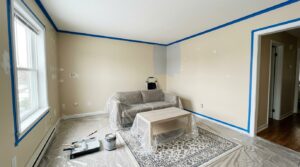
Limewash Walls in Great Neck: Choosing Movement, Color and the Right Product
Limewash-style walls appeal to homeowners who want color that feels less uniform than conventional paint. The attraction is often softness: gentle movement, changing tone and a surface that responds to light. For a Great Neck interior, the important questions are how much variation you want and which product is compatible with the wall. A finish should be chosen as a complete system, not by a social-media label.
Know what the product actually is
Limewash, mineralwash and other decorative mineral coatings are not automatically the same material. Some products are formulated for absorbent masonry; others are designed for interior drywall with specific preparation. A brand may offer both types under different names. Read the selected product’s instructions rather than assuming a limewash recipe works everywhere.
This distinction has practical consequences. A masonry coating applied to an unsuitable painted wall may not behave as intended. The right preparation also depends on whether the surface is bare, previously painted or repaired. Ask the estimate to identify the intended system. The finish’s appearance is only one reason to select it; substrate compatibility is essential.
Decide whether you want subtle or expressive movement
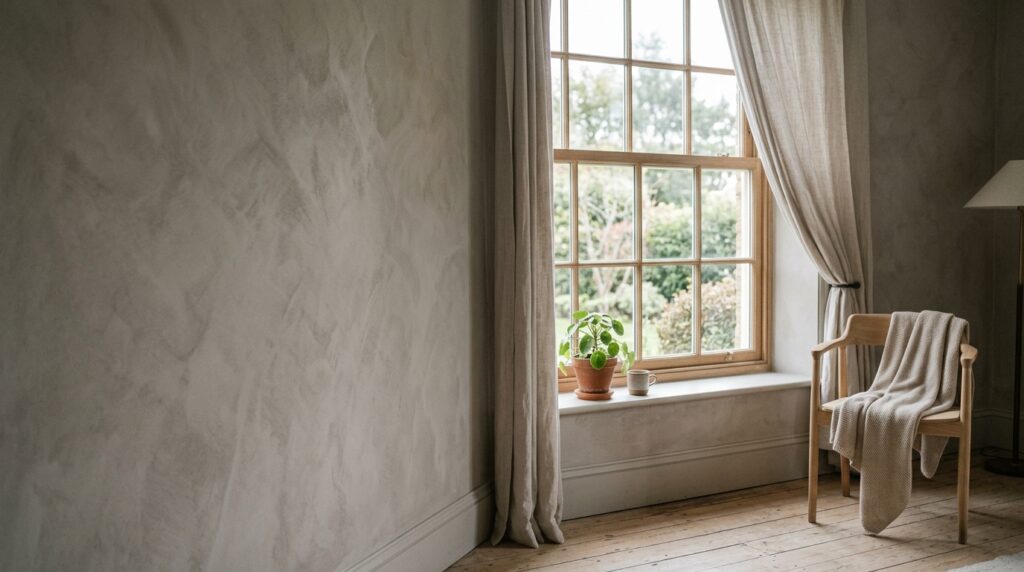
A quiet limewash-style finish can create gentle shifts in tone without becoming the room’s focal point. More pronounced brush movement can make the wall itself a decorative feature. Neither is inherently better. The choice depends on furniture, textiles, lighting and how much visual activity the room already contains.
Save references with different movement levels and explain which one you prefer. Do not use the same word textured to describe both visible brush variation and a physically coarse surface. They are different qualities. A sample should clarify the distinction so you do not approve a soft-looking image and later discover that the intended application is much more dramatic.
Understand how the base affects appearance
Existing wall texture remains relevant even when a coating creates tonal movement. Broad ridges, uneven patches and open joints should be reviewed before application. The finish may soften an impression of uniformity, but it is not a reliable way to conceal structural problems or unstable paint. Moisture stains need their cause resolved.
Preparation is product-specific
Ask whether the wall needs cleaning, repair, smoothing or a particular primer. Requirements vary by formulation. The answer should come from the selected system and observed substrate, not a blanket statement that all mineral finishes bond to everything. If older painted surfaces will be disturbed, discuss the appropriate lead-safe assessment and qualified work practices first.
Choose color beside the materials that remain
A neutral finish is not automatically neutral in every room. Cream, beige, gray and muted green can shift noticeably beside floors, stone and upholstery. Movement within the finish can make some areas appear lighter or darker. Consider that effect when choosing a color for an entire room rather than an isolated feature wall.
Great Neck homeowners planning an update alongside new furniture should share that direction early. If furnishings are not yet selected, identify the fixed materials that provide a dependable starting point. Review the proposed sample in the actual room when possible. Digital images and paint names are useful references, but they cannot substitute for a physical color decision.
Review the wall under day and evening light
Limewash-style variation can look restrained under diffuse daylight and more visible beside a directional fixture. A wall near a large window may reveal movement differently from one in a shaded alcove. Walk around the space and consider the finish from the positions where people normally sit or enter.
If lighting will change during the project, make that part of the brief. A new sconce can graze a surface and reveal texture more strongly than the original ceiling fixture. Ask whether a sample can be viewed under representative lighting. The goal is not to eliminate all variation but to judge whether the intended effect feels right in your room.
 Match the finish to room use
A formal sitting room, children’s play space and narrow passage do not receive the same contact. Consider hands, furniture movement, bags and food splashes. A finish chosen only for photographs may be frustrating if it requires care that does not suit daily life. Ask about cleaning before deciding on the final material.
In kitchens and bathrooms, identify exact exposure. A dry wall away from a sink is different from a backsplash or shower area. Terms such as breathable or natural do not establish waterproofing or stain resistance. Use the manufacturer-approved system for the location, and choose another coating if its care requirements do not fit the room.
Consider a feature wall before committing to every surface
A single wall can introduce mineral movement while keeping adjoining areas easier to maintain. It can also reveal how the finish interacts with the room before a larger design commitment. The choice should follow architecture: a fireplace wall, a recess or an uninterrupted sitting-room surface may offer a clear boundary.
Avoid placing the finish wherever there is spare wall space without considering transitions. Outside corners, door frames and ceiling lines should have an intentional stopping point. If the finish wraps several walls, discuss continuity and variation across changing light conditions. A finish plan should describe the room’s composition rather than treating every square foot as equivalent.
Compare limewash with plaster and conventional paint
Conventional paint is often selected for a relatively uniform appearance and familiar maintenance. Limewash-style coatings emphasize tonal movement. Decorative plaster can produce a different sense of depth and surface character, with the result depending on the product and technique. These options overlap visually but are not interchangeable specifications.
When uncertain, ask to compare samples that answer the same design question. For example, compare two quiet warm finishes rather than an intensely patterned limewash image with a glossy plaster photograph. Consider preparation, care and repair alongside appearance. The option with the most striking image is not necessarily the most suitable wall system for your home.
Build an estimate around your actual walls
The useful estimate includes wall area, existing condition, required preparation, selected product and application scope. Confirm whether a sample or protective treatment is included. Ask how corners, high ceilings and furniture protection affect access. A competitor’s online rate does not establish the cost for your Great Neck property.
If the room has wallpaper, adhesive residue or unresolved dampness, disclose it at the beginning. Those conditions may create separate work before decorative finishing can be priced accurately. Distinguish essential substrate work from optional design choices so the proposal is understandable. A clear scope prevents a low initial price from concealing incomplete preparation.
Keep the care information after completion
Ask for the finish name, color information and cleaning guidance. Do not assume a general household cleaner is suitable. Wait for the specified cure period before cleaning or subjecting the surface to frequent contact. Care instructions should reflect the selected system, including any protective treatment.
A localized touch-up may be visible because the original movement cannot always be recreated in a small patch. If future wall fixings or electrical work are planned, complete them before the decorative finish where practical. Retaining the material specification helps later repairs, but it does not guarantee an invisible match. Maintenance expectations belong in the decision before application.
Questions to resolve before approving limewash
Write your preferred movement level in words and attach one representative image. Include another image you do not want, with a short reason. This makes differences such as too cloudy, too dark or too uniform easier to discuss than a vague request for a natural finish.
Record the room’s main activities and the places most likely to be touched or splashed. Note whether existing wall texture is acceptable or should be reduced. Confirm the specific product’s suitability for painted drywall rather than relying on the general name limewash.
For your estimate request, send wall photographs, approximate dimensions and the Great Neck address. Include current coatings, prior leaks and any furniture that cannot be moved easily. Ask ROL Remodeling to discuss the proposed decorative system and confirm nearby Nassau North Shore availability for the actual property.
An illustrative limewash choice
Suppose a Great Neck homeowner wants soft movement on a family-room wall and saves a masonry limewash photograph as inspiration. The image can communicate color and atmosphere, but it does not prove the depicted product is suitable for the painted drywall in the home. The specification needs to identify an appropriate interior system.
The family room also has frequent hand contact near a doorway. A physical sample can help judge the movement, while product guidance should establish care and repair expectations. If the proposed finish does not fit that use, limiting it to a quieter feature area or selecting another coating may be more practical.
This is an illustrative scenario rather than a completed ROL job. It shows why appearance and compatibility must be considered together. A finish should not be selected solely because several different products share the word limewash in online descriptions.
Discuss the project with ROL Remodeling
For a property-specific conversation, review limewash painting in Great Neck and our broader coverage information. Send your address, photographs and goals through the project estimate form. Confirm the service scope and current availability before scheduling.