Wallpaper Removal on the Upper East Side: What Happens Before Repainting?
Removing wallpaper reveals the next set of decisions. The wall beneath may be sound, or it may contain adhesive residue, old repairs and damaged surface material. For an Upper East Side apartment, the useful plan connects removal to the intended next finish. A bare-looking wall is not automatically ready for paint, and the removal method should not be chosen without considering the covering and substrate.
Identify the covering without destructive testing
Wallpaper products vary. Paper, vinyl-faced coverings, fabric-like materials and multiple old layers can behave differently during removal. Installation history also matters: a properly prepared wall can release differently from a surface where adhesive was applied directly to vulnerable material. Share any known product or installation information.
Avoid pulling away broad sections merely to see what happens. An uncontrolled test can damage drywall facing or expose unknown older coatings. Ask for an appropriate assessment. Photographs of seams, corners and loose areas may help an initial discussion, but they do not establish the complete condition. A removal estimate should explain what is known and what remains uncertain.
Define the result you want afterward
Do you want ordinary paint, a smoother wall, a decorative plaster finish or another covering? Each outcome can require a different preparation standard. Selecting the next finish early helps avoid paying for an incomplete base that later needs additional work.
A highly reflective coating can reveal irregularities that a flatter finish softens. A mineral or decorative system may require product-specific primers or substrate preparation. Explain the intended appearance rather than saying make the wall ready without defining ready for what. The contractor should be able to connect removal, cleaning and repair to the actual finish being proposed.
Understand the adhesive issue
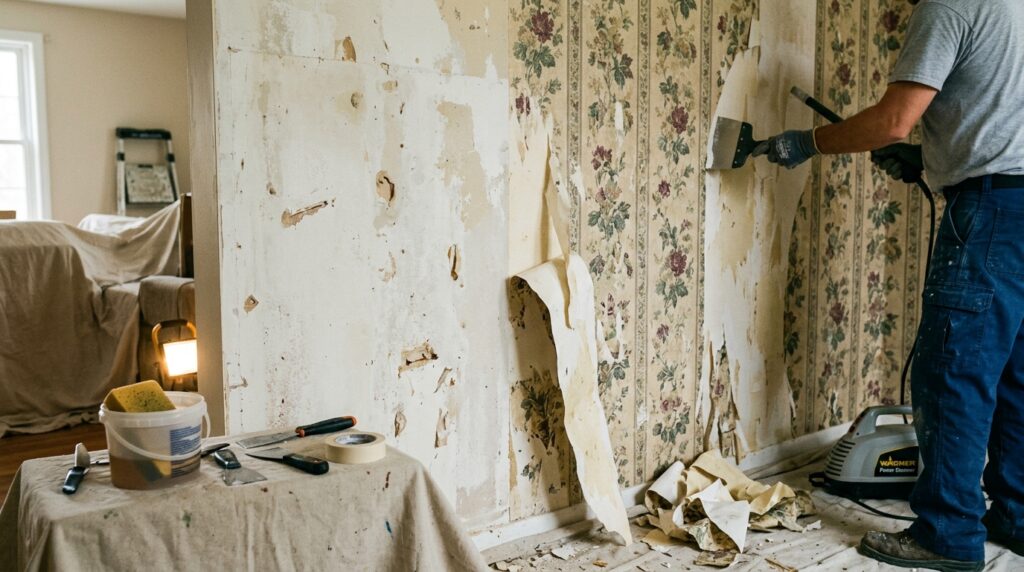
Wallpaper can come away while adhesive remains. Residue may not be obvious in every light, but it can interfere with subsequent coatings. The correct treatment depends on the adhesive, wall and selected paint system. Ask how that part of the work is addressed, not only how the visible paper will be removed.
A proposal that ends at stripping may leave cleaning or preparation to another trade. That can be acceptable if clearly documented. Problems arise when the owner assumes removal includes every step before painting and the contractor assumes it does not. Clarify responsibility for residue, drying, repairs and priming in the written scope before work begins.
Expect the exposed wall to need assessment
The covering may conceal old patching, stains or damaged surfaces. Removal can also reveal weak areas that were not visible during the estimate. These findings do not mean every wall needs complete reconstruction, but they should not be hidden beneath paint without review.
Plan how additional repairs are approved
Ask what repair allowance is included and how unexpected conditions will be documented. Photographs and a revised scope help distinguish necessary substrate work from optional upgrades. If the exposed wall is broadly uneven, discuss smoothing separately from isolated filling. A clear approval process prevents the final preparation from becoming an open-ended assumption on either side.
Distinguish drywall damage from plaster issues
Damaged drywall facing presents different questions from loose plaster or repeated cracks. The substrate influences what repair and preparation are appropriate. An owner does not need to identify every material correctly, but should avoid insisting on one technique before assessment.
If walls are unstable, damp or moving, decorative work should wait until the cause is understood. Painting cannot stabilize loose material or stop a leak. Upper East Side properties vary in age and construction, so a neighborhood label cannot determine the wall system. The actual property and exposed condition should guide the repair discussion.
Consider older painted layers and safety
Wallpaper age does not prove the age of paint underneath it. Older buildings may contain lead-painted surfaces, and disturbing them can require specific assessment and work practices. Do not sand or scrape unknown underlying paint as a do-it-yourself test.
The EPA RRP program applies to covered paid renovation, repair and painting work in pre-1978 housing and child-occupied facilities. Confirm relevant requirements and contractor qualifications before disturbance. A wallpaper contractor’s general description of experience is not proof of lead-safe certification. Where another qualified firm is needed, that role should be resolved before the work is scheduled.
 Coordinate furniture and occupied-room use
Removal may involve moisture, tools and protection measures that affect room access. Tell the contractor about upholstered furniture, built-ins, sensitive belongings and the routes that must remain open. Clarify who moves items and where they can be stored.
For an apartment, obtain management requirements on working hours, common-area protection, deliveries and elevator use. A small room can still be logistically demanding if it is the only passage to another occupied space. Explain those constraints before asking for a completion date. Planning around real access is more reliable than assuming every bedroom or hallway takes the same time.
Allow the wall to reach the next stage properly
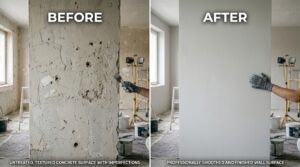
A wall exposed during removal may need time and treatment before repair or painting. Product instructions and site conditions determine the sequence. Do not assume that finishing can begin the instant the last strip is removed.
Ask which stages are included: covering removal, adhesive treatment, substrate assessment, repairs, preparation and new coating. If different contractors handle those stages, agree on the handoff condition. The next trade should not arrive expecting a paint-ready wall when the previous scope only promised removal. Documenting that transition is particularly helpful in larger apartment renovations.
Compare estimates beyond the word removal
The same room can produce different quotations because one includes cleaning and minor repairs while another does not. Identify the covered surfaces, assumed number of layers, protection, disposal and preparation extent. Ask how ceilings, high areas and spaces behind fixtures are treated.
A final price based on assessment is more meaningful than a generic per-room figure found online. Access, adhesion and underlying conditions influence the work. Avoid using a competitor’s rate as a ROL price promise. Compare what each scope actually delivers and whether it supports the next finish you intend to install.
Inspect before committing to the final coating
After removal and preparation, review the exposed surface with the contractor. Confirm that known adhesive issues and repair needs have been addressed for the chosen system. If a decorative finish is planned, this is the point to resolve compatibility rather than discovering it after application.
Keep the finish specification and care information after completion. If the wall had moisture or recurring cracks, retain the investigation and repair notes too. Future marks should be assessed in context rather than automatically covered with another decorative layer. The purpose of the removal project is a sound next stage, not simply a temporarily bare wall.
Build a clear removal-and-repaint brief
List the rooms and covered surfaces, including recesses or areas behind furniture. Add photographs of seams and any existing loose sections without enlarging them. Note whether you know the wallpaper type, installation date or number of layers.
Describe the intended new finish and any planned lighting changes. Ask the proposal to distinguish removal from adhesive treatment, wall repairs and painting. Record who handles management approvals and who clears the room.
For an Upper East Side project, send ROL Remodeling the address, approximate coverage and access requirements. Request an estimate with explicit substrate assumptions and a process for unexpected repair findings. Nearby Yorkville and Lenox Hill availability should be confirmed for the actual property.
An illustrative removal-and-finish decision
Suppose an Upper East Side owner requests wallpaper removal and intends to repaint immediately. After assessment, the proposal needs to distinguish stripping from adhesive treatment and the condition required for the chosen coating. Those stages should not be left as assumptions hidden behind the word removal.
If the exposed surface has localized damage, a limited repair may be sufficient. If it has broad texture variation and the owner chooses a reflective finish, the preparation discussion may be wider. Neither outcome can be promised solely from the room’s size or a photograph of the intact wallpaper.
This hypothetical example is not a ROL project account. Its purpose is to clarify the handoff: what the removal scope delivers, who addresses any repairs and when the next coating can appropriately begin. That clarity makes estimates more comparable and the sequence easier to understand.
Discuss the project with ROL Remodeling
For a property-specific conversation, review wallpaper removal in Upper East Side and our broader coverage information. Send your address, photographs and goals through the project estimate form. Confirm the service scope and current availability before scheduling.