Marmorino vs Polished Venetian Plaster: Choosing a Manhattan Wall Finish
Marmorino and Venetian plaster are often presented as competing choices, but the terminology is more nuanced. Marmorino can belong within the broader family of decorative Venetian-style plasters. What matters to a Manhattan property owner is the specified material, application and appearance—not an oversimplified label. Compare samples, substrate requirements and maintenance to select a finish that fits the actual interior.
Clarify the names before comparing prices
Decorative plaster names are used differently across suppliers and contractors. Some describe a material tradition; others identify a particular product or technique. A quotation for Venetian plaster could refer to a highly polished system or a quieter finish. A Marmorino sample might show a stone-inspired matte character, but that is not a promise about every product carrying the name.
Ask for the exact proposed material and finish direction. A useful comparison identifies formulation, texture, sheen and intended use. Avoid assuming that one name guarantees luxury or another automatically means lower cost. If proposals use different terminology, compare the visible sample and complete preparation scope before deciding that they describe equivalent work.
Compare aggregate and surface character
Different decorative plasters use different mineral components and particle sizes. These can influence smoothness and the impression of depth. A finish with more visible grain may feel less mirror-like than a finely polished surface, while still appearing refined. The result also depends on how the product is worked.
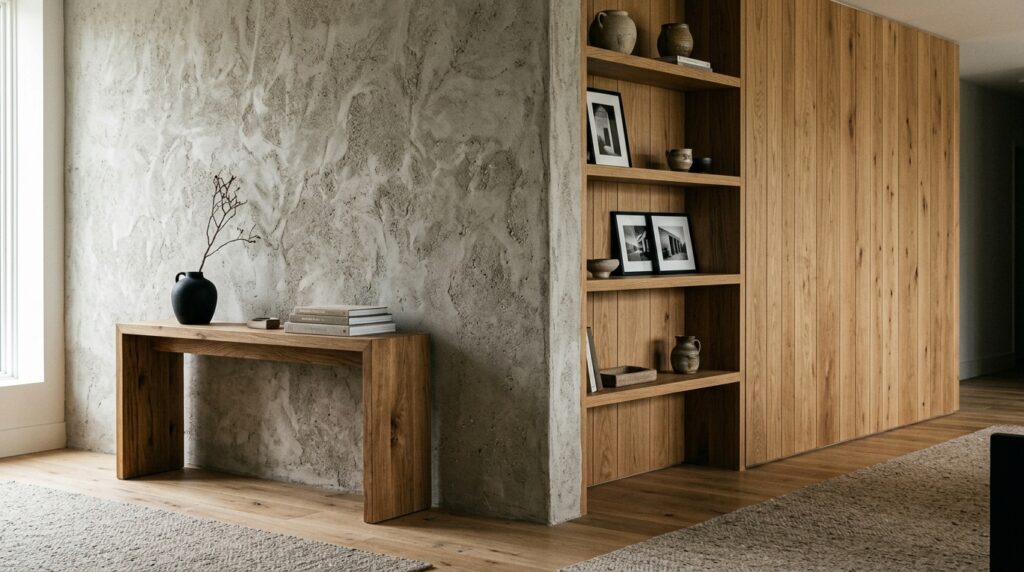
Do not judge texture only through a distant room photograph. Ask to see a close view and a representative physical sample. Consider whether you want a surface that reads mainly as color, one with soft mineral variation or one with more pronounced material character. These preferences help narrow the discussion without pretending that all Marmorino behaves identically.
Treat sheen as a design decision
A reflective finish can make a wall feel more formal and emphasize light sources. A lower-sheen finish may feel quieter beside wood, fabric or natural stone. Neither is inherently more appropriate for a Manhattan apartment. The decision depends on the amount of reflected light and visual activity you want.
Examine the room from normal positions
Stand at the entry and sit where the room will be used. A reflection that looks appealing from one angle may be distracting from another. Ask how wall sconces, window light or a bright opposite wall affect the sample. If fixtures are changing, include them in the design brief rather than evaluating the finish under obsolete lighting.
Build the finish around the existing materials
Stone flooring, fireplace surrounds and wood cabinetry can establish the room’s strongest undertones. A plaster color should relate to those materials instead of being chosen from a disconnected digital image. Mineral movement may reveal more than one apparent tone, which makes physical comparison especially useful.
A stone-inspired finish does not need to imitate the existing stone literally. It may work better as a quieter companion than as a competing pattern. Decide whether the wall should recede or become a focal point. In rooms with strongly veined surfaces, restrained movement can prevent the composition from becoming visually crowded. The appropriate answer is room-specific.
Understand what preparation the wall needs
Plaster appearance depends on the base beneath it. Existing coatings, broad texture variation, damaged edges and old repairs need assessment. A decorative layer should not be used to cover active cracks or unresolved moisture. Ask how the proposed preparation creates a compatible and stable surface for the selected product.
In older Manhattan buildings, painted surfaces may require a lead-safe assessment before sanding or other disturbance. Confirm relevant qualifications and work practices. If another contractor is responsible for underlying repairs, establish a handoff condition before the decorative work is scheduled. Otherwise the finish installer may arrive before the substrate is ready for the specified application.
Plan corners and transitions as part of the design
A decorative wall is rarely just a rectangle. Window returns, door openings, recesses and outside corners affect how the finish is perceived. Identify where plaster stops and adjacent paint begins. A boundary placed arbitrarily can make a premium surface feel like an afterthought.
Ask how the finish relates to trim and built-ins. If those elements will be installed later, coordinate the sequence to avoid damage or incomplete areas. In an entry or hallway, consider nearby light switches and repeated contact. The edge treatment and maintenance plan should reflect how the surface will actually be used, not only how it appears in a styled image.
 Do not equate mineral with waterproof
Lime-based or mineral descriptions do not establish suitability for direct water exposure. A powder-room wall differs from a shower enclosure. The manufacturer-approved system, including any required protective treatment, must suit the intended location. Decorative plaster is not a substitute for underlying wet-area waterproofing.
Discuss ventilation and existing moisture before choosing the finish. Cleaning requirements can also rule out a visually appealing product for a high-contact area. Ask what products and methods are allowed after curing. If the intended maintenance involves vigorous scrubbing or frequent splashes, confirm suitability instead of relying on generalized claims about natural materials.
Compare the complete application scope
Cost is influenced by substrate condition, wall geometry, finish technique, area and access. A small feature wall with difficult corners may not price like a large open surface. A quotation that excludes repairs or samples cannot be fairly compared with one that includes them.
Manhattan building logistics also matter: work hours, elevator reservations, delivery access and management documentation. Obtain current requirements and share them before final scheduling. Published competitor prices are not a ROL price schedule and may describe different conditions. Ask for an estimate tied to your wall and the approved sample, with assumptions and exclusions clearly stated.
Consider maintenance before the final selection
A hand-applied finish may be harder to repair invisibly than ordinary paint. Color, movement, sheen and age all influence the appearance of a touch-up. Ask what happens if a future wall fixing, furniture impact or electrical change damages the surface. A care plan is part of selecting the material.
Keep the product name, tint information and sample reference. Follow the selected manufacturer’s cure and cleaning guidance. Protective treatments can alter appearance, so they should be included in the approved sample where relevant. Do not add a generic sealer later without confirming compatibility; an unplanned coating may change the very character you selected.
Let samples resolve the choice
If both Marmorino and a polished finish appeal to you, compare them using similar colors and representative room lighting. Otherwise differences in color can disguise what you are trying to evaluate about texture and sheen. Ask each sample to answer a clear question about the intended room.
A quieter finish may complement strongly patterned furnishings, while a polished wall may support a more restrained interior. These are design possibilities rather than rules. The better choice is the one whose appearance, preparation and maintenance expectations you understand. A clear specification is more valuable than choosing the finish with the most impressive-sounding name.
Your material comparison notes
Create a short list for each candidate: product, sample color, sheen, visible movement, approved substrate and cleaning method. Include whether the estimate covers repairs, primers and protective treatments. This makes the comparison about the finished wall rather than two marketing labels.
Record the surface location and exposure. For a living room, note the fixed flooring and typical evening lighting. For a hallway, describe frequent contact. For a bathroom, specify whether the wall is dry, splash-prone or inside a shower; those distinctions can determine suitability.
Send ROL Remodeling the Manhattan address, wall photographs and the samples or reference images you are comparing. Request a discussion of the appropriate decorative scope and building access. Confirm actual neighborhood availability and any product-specific recommendation before committing to the project.
An illustrative plaster comparison
Imagine a Manhattan room with strongly veined stone and understated wood furniture. The owner compares a polished plaster image with a quieter Marmorino reference. Comparing two completely different colors would make it difficult to isolate the effect of sheen and movement. Similar-toned samples under the room’s actual lighting provide a clearer test.
If the polished sample creates reflections that compete with the stone, a softer surface may better support the room. If stronger reflection is intentional, the polished option may still suit the design. Neither conclusion follows automatically from the product name.
This example is hypothetical, not an account of a ROL project. The planning lesson is to ask samples a specific question and compare the complete systems. The estimate should also identify preparation and care requirements, because a preferred appearance alone does not resolve suitability.
Discuss the project with ROL Remodeling
For a property-specific conversation, review marmorino plaster in Manhattan and our broader coverage information. Send your address, photographs and goals through the project estimate form. Confirm the service scope and current availability before scheduling.